Buying guide
IPTV subscription cost in 2026: what you actually pay
IPTV subscription cost in 2026, broken down by device count and term: monthly totals, annual totals, hardware, hidden fees and what changes with currency.
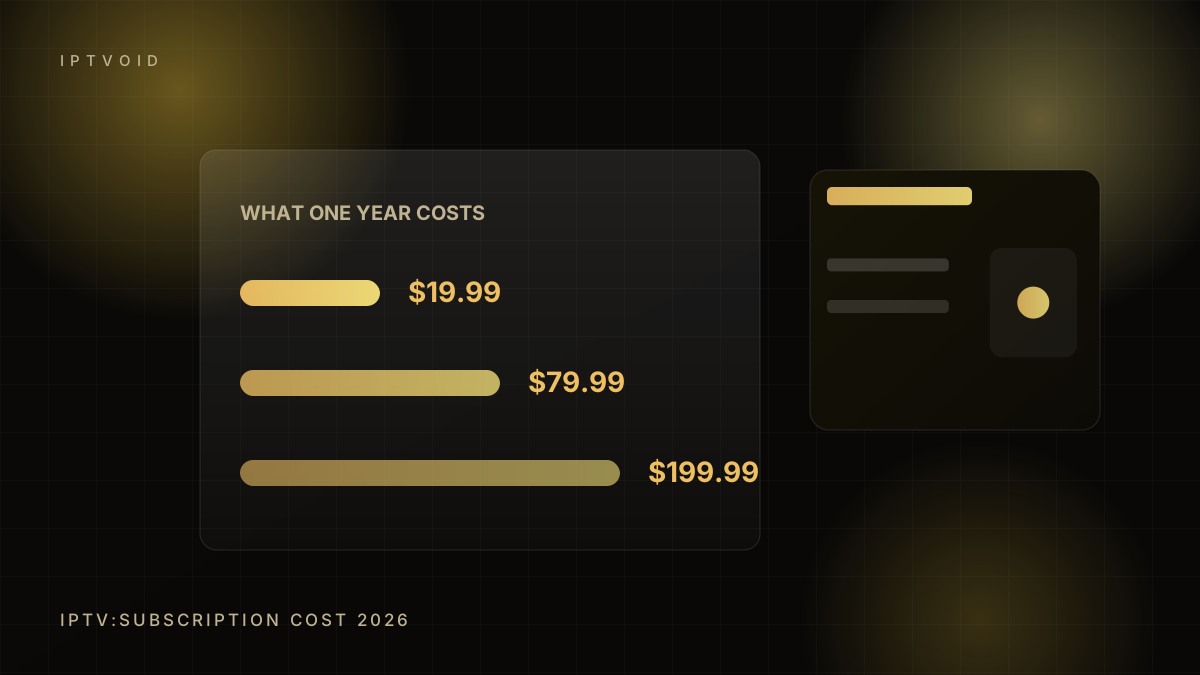
In short: IPTV subscription cost in 2026
An IPTV subscription in 2026 typically costs between $10 and $25 per month for one device, or $70 to $200 per year depending on the device count. Longer terms lower the monthly equivalent but increase upfront risk. Device count, not channel count, is usually the main price variable. Always test with a trial first. IPTV subscription cost depends on two variables: how many devices run at once and how long you commit. This page breaks down IPTV subscription cost by tier and term, including hardware and the fees competitors hide.
IPTV subscription cost: the short answer
Most IPTV subscriptions in 2026 fall into three price bands. A single-device monthly plan usually costs $10 to $25. A six-month plan usually costs $45 to $110. A twelve-month plan usually costs $70 to $200. The exact figure depends far more on how many devices stream at once than on how many channels a seller advertises.
That is the first thing to understand: channel counts are marketing, device connections are cost. Every simultaneous stream consumes bandwidth and server capacity, so providers price by connection.
The three pricing models you will see
| Model | Typical range | What it means | Main risk |
|---|---|---|---|
| Monthly | $10–$25 per device | Low commitment, highest monthly cost | Price can change at renewal |
| 3–6 months | $30–$110 | Balanced commitment and discount | You cannot test the full term |
| 12 months | $70–$200 | Lowest monthly equivalent | Most money exposed if the service fails |
A monthly plan is not bad value. It is insurance. If you are trying a provider for the first time, one month costs less than losing a year of prepaid access.
Why device count changes the price
A one-device plan allows one stream at a time. A four-device plan allows four. The difference is not a software switch; it is four times the concurrent capacity. That is why a four-device plan usually costs two to three times a one-device plan, not four times.
For a household, count the screens that are actually on at the same time. A family with one living-room TV and one bedroom TV needs two devices. A household where everyone watches on a phone in a different room may need three or four. Counting installed devices is the wrong method, because installations are unlimited on most plans.
The monthly-equivalent trap
Long plans are marketed with a monthly-equivalent price. A $69.99 twelve-month plan is $5.83 per month. That looks far cheaper than $19.99 per month, and it is. But the comparison is only fair if the service lasts the year.
Do this calculation before buying:
- Write down the monthly price.
- Multiply by the number of months in the long plan.
- Subtract the long-plan price.
- Ask whether you would risk that difference on an unproven provider.
With IPTVOID's one-device prices, twelve months at $69.99 versus twelve monthly payments at $19.99 is a difference of $169.89. The annual plan is much cheaper, but only if you have already tested the service.
What an IPTV subscription cost should include
A fair price includes more than a login. Check for:
- A working programme guide (EPG), not just a channel list
- Catch-up or replay on the channels you watch
- A player recommendation for your device
- Setup help in a real chat, not a FAQ page
- A trial before payment
- A written refund policy
- A clear device-connection limit
If any of those are missing, the cheapest quote is not the cheapest service.
Hidden costs people forget
Hardware. You may need a Fire TV Stick, Android box or Ethernet adapter. A weak Wi-Fi signal is the most common cause of buffering, and a $20 adapter can fix it.
A player app. Some players are free; some charge a one-off or annual fee. TiviMate, for example, has a free tier and paid features. Budget for it if you need recording or multiple playlists.
A VPN. Not usually required, but some networks throttle streaming. A VPN can help or hurt, and it adds a monthly cost. Test without one first.
Time. Setup and troubleshooting take time. A provider that answers questions quickly is worth more than one that saves you $2 a month and disappears.
How to compare two quotes fairly
Put both quotes in the same units. Convert everything to cost per month per simultaneous device. Then compare what is included.
| Quote | Term | Devices | Upfront | Per month | Per device/month |
|---|---|---|---|---|---|
| A | 1 month | 1 | $19.99 | $19.99 | $19.99 |
| B | 12 months | 1 | $69.99 | $5.83 | $5.83 |
| C | 6 months | 2 | $79.99 | $13.33 | $6.67 |
| D | 12 months | 4 | $199.99 | $16.67 | $4.17 |
The four-device annual plan has the lowest per-device cost, but it also has the largest upfront exposure. That trade-off is the whole decision.
When cheap becomes expensive
A $5 monthly plan that buffers during every live match is not cheap. A $20 plan that works is better value. The practical test is a trial during the hours you actually watch: evenings and weekends, not Tuesday at 11am.
Use the trial to test the channels you care about, the device you own and the player you intend to keep. If the trial is smooth at peak time, the paid plan is likely to be smooth too.
A note on currency
Many providers quote in US dollars. If you pay from a bank account in another currency, the amount debited can differ because of the conversion rate and fees charged by your bank or wallet. Ask which currency the provider settles in, and confirm the exact amount in writing before paying. On IPTVOID, every plan is quoted in USD only; the USD amount confirmed in WhatsApp is the amount that applies.
The bottom line
A realistic IPTV budget in 2026 is $15 to $25 per month for one device, or $70 to $200 per year for a household. Pay monthly until you trust the service, then move to a longer plan if the maths works for you. Never let a low monthly-equivalent price talk you out of testing first.
Frequently asked questions
Is a 12-month IPTV subscription cheaper than monthly?
Yes, almost always. A 12-month plan lowers the monthly equivalent because the provider locks in the term. The trade-off is upfront risk: you pay for a year before you know how the service performs across seasons and peak events.
Why do IPTV prices differ by device count?
Each device is a simultaneous stream, which uses bandwidth and server capacity. A four-device plan costs more because it supports four viewers at once, not because it unlocks more channels. Installations are usually unlimited.
Should I pay monthly or yearly for IPTV?
Start monthly or with a short plan until you have tested peak-time playback, support and the channels you watch. Move to a longer term only after the service has proven reliable for you.
Keep reading
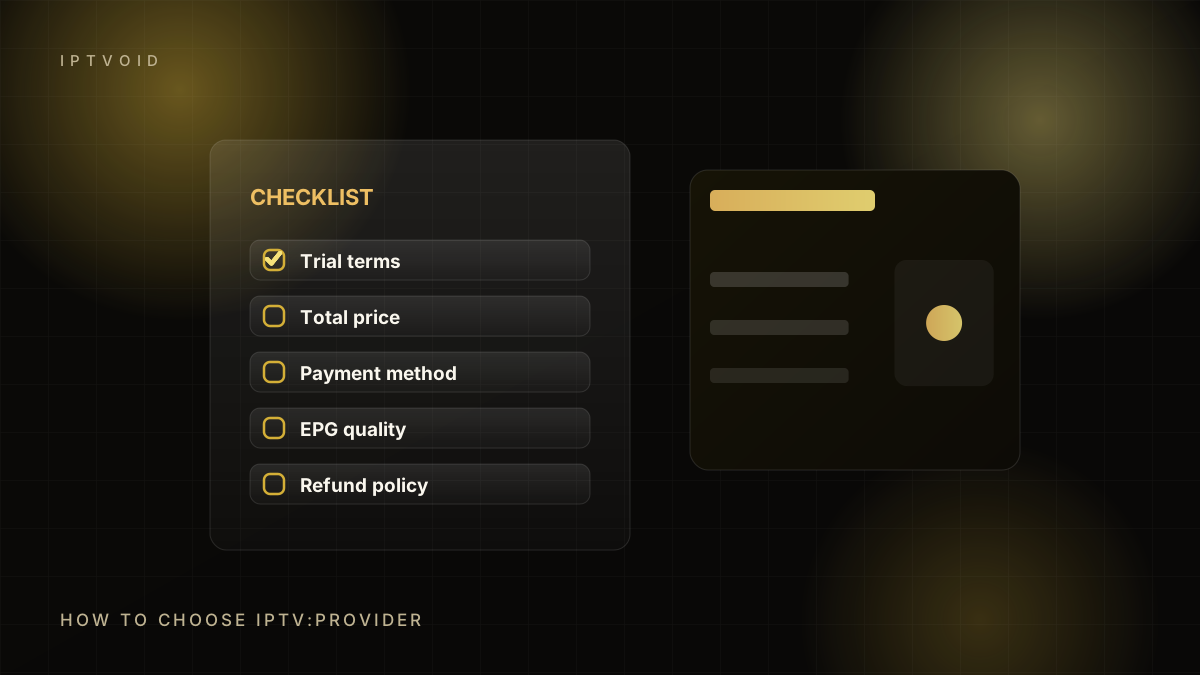
Choosing an IPTV provider without getting burned
A practical checklist for choosing an IPTV provider in 2026: trials, payment risk, support tests, device support, EPG quality and red flags.
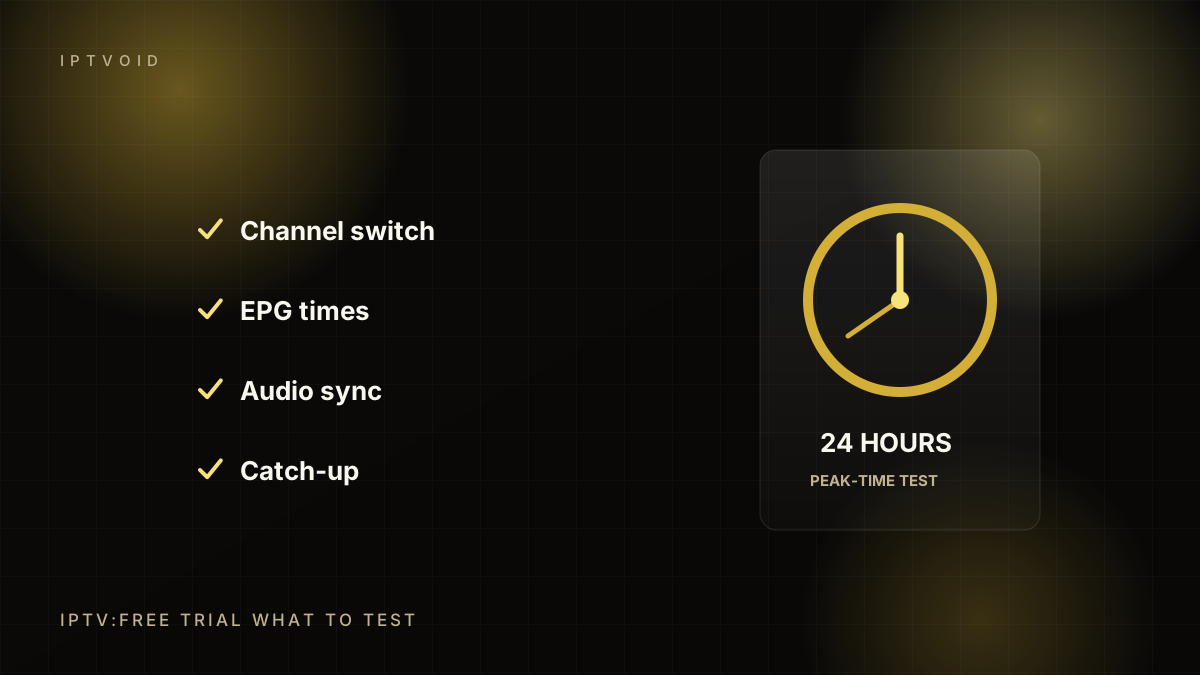
IPTV free trial: what to test in 24 hours
How to use an IPTV free trial properly: peak-time tests, channel zapping, EPG, catch-up, 4K, multi-device checks and the questions to ask support.
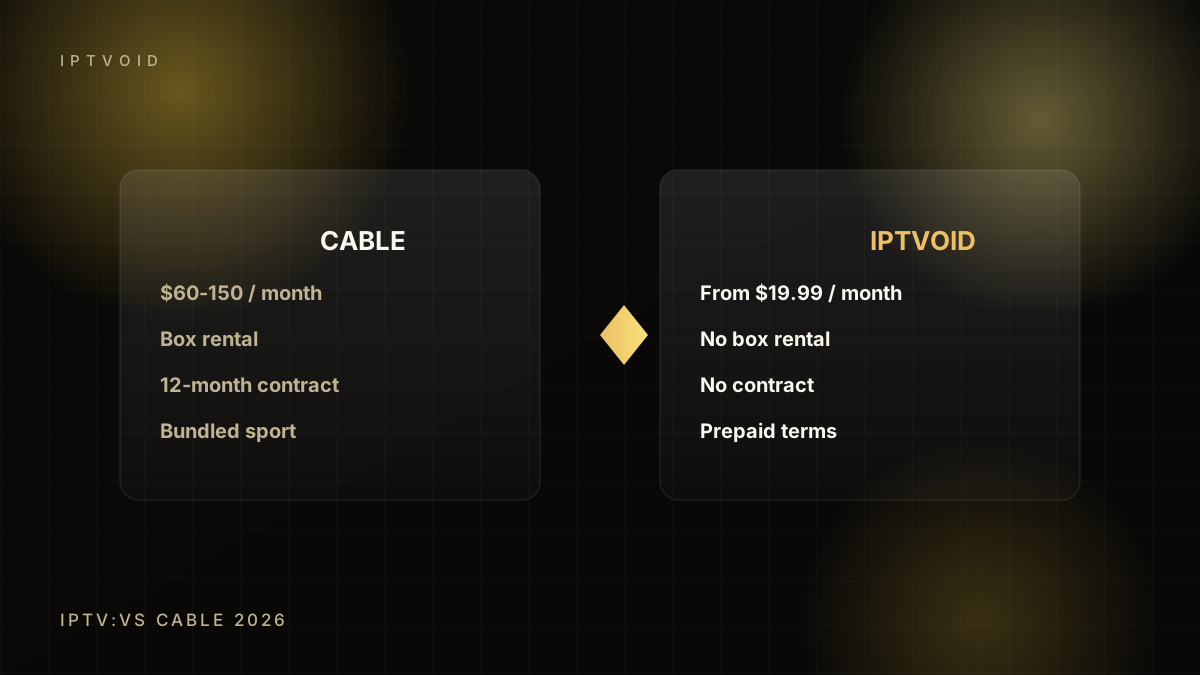
IPTV vs cable in 2026: an honest comparison
A neutral comparison of IPTV and cable TV in 2026: monthly cost, contracts, hardware, sports, reliability and the trade-offs nobody mentions.
Next step
Put the advice into practice
Start with a free trial, test at peak time, then choose the device count and term that fit your household.