Comparison
IPTV vs cable in 2026: an honest comparison
IPTV vs cable in 2026: compare monthly cost, hardware rental, contracts, sports tiers and picture quality, with the trade-offs stated plainly.
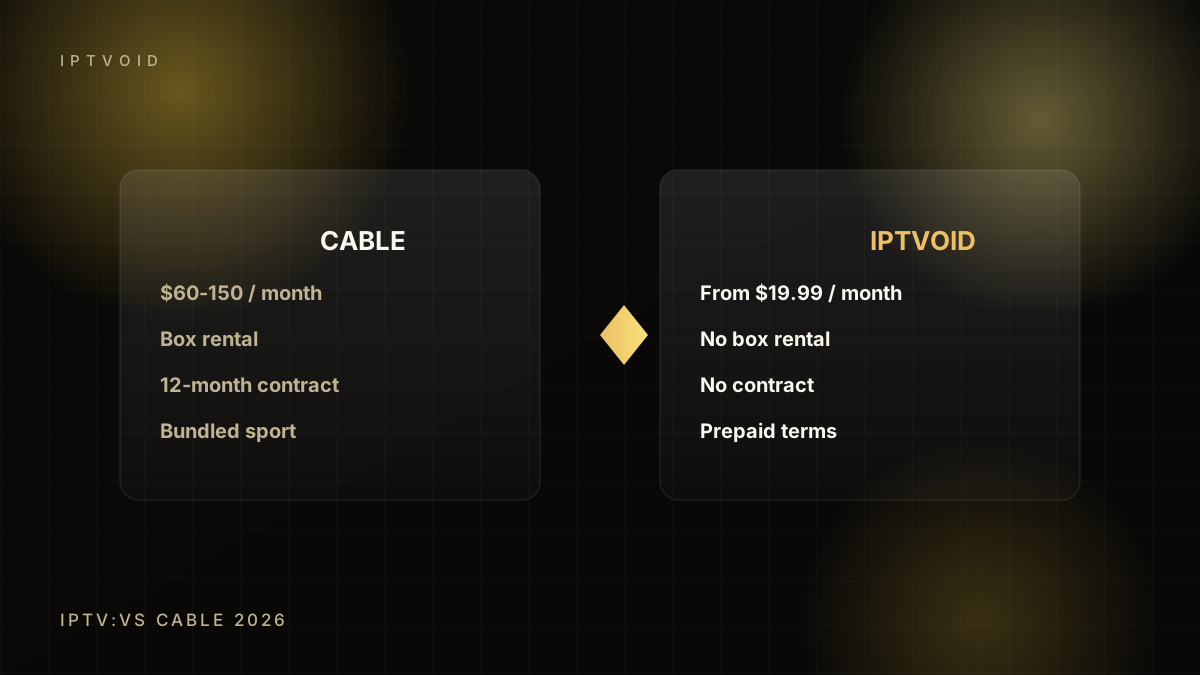
In short: IPTV vs cable TV
Cable TV bundles usually cost more per month and come with contracts, hardware and regional channel packages. IPTV plans are cheaper upfront and work on devices you own, but quality depends on your connection and provider. Cable is more predictable; IPTV is more flexible. The right choice depends on how much live sport you watch and how good your internet is. IPTV vs cable TV is not a fair fight on price alone. Cable TV still wins on bundled sport and installation, while IPTV wins on flexibility. This page compares cable TV and IPTV costs side by side, and says where cable TV remains the better buy.
Two different products
Cable TV is a managed service. The operator controls the network, the set-top box, the channel line-up and the support desk. IPTV is a streaming service delivered over your internet connection. You control the device and the app; the provider controls the access credentials.
That difference explains almost every trade-off below, and it is the heart of the IPTV vs cable question. Cable is more predictable. IPTV is more flexible and usually cheaper. Neither is better in every household.
Cost
Cable pricing varies enormously by country and bundle. A typical subscription with a sports tier, HD boxes and fees often lands between $60 and $150 per month. Those figures are illustrative; the point is the structure, not the exact number.
IPTV pricing is usually simpler. A one-device monthly plan is often $10 to $25. A four-device annual plan is often $150 to $250. There is no box rental, no installation fee and no contract.
| Cost item | Cable | IPTV |
|---|---|---|
| Monthly subscription | $60–$150 typical bundle | $10–$25 per device |
| Set-top box | Rental or purchase | Use your own device |
| Installation | Often a scheduled visit | Self-setup with support |
| Contract | 12–24 months common | Prepaid, no contract |
| Equipment fee | Common | None |
| Early termination | Often charged | None |
The monthly gap is large, and in most households the bill is what settles IPTV vs cable in the end. The catch is that IPTV quality depends on your internet connection, while cable does not.
Cable TV reliability vs IPTV
Cable has a dedicated line and a managed signal. When it fails, there is a support number and a truck roll. Outages are inconvenient but bounded.
IPTV depends on your Wi-Fi, your router, your device and the provider's servers. A weak signal behind a TV can cause buffering that looks like a provider problem. A congested evening network can do the same.
In practice:
- Cable is more predictable for a non-technical household.
- IPTV is more reliable than cable when the network is good and the provider is competent.
- IPTV is worse than cable when the network is poor or the provider oversells capacity.
A wired connection and a decent router close most of the gap.
Channels and content
Cable bundles are built around regional packages. You pay for a base tier and add sports, movies or international channels. The line-up is stable and published.
IPTV line-ups are broader on paper but less predictable. Channels appear and disappear, regional feeds differ, and on-demand catalogues change. A provider that promises "every channel in the world" is making a claim nobody can verify.
If you watch a specific regional channel every day, confirm it is present in a trial before you commit. If you watch whatever is on, breadth matters less.
Sports
Live sport is the hardest test for any IPTV service. It combines peak audience, fast motion and high bitrate. It is also the reason many households reconsider IPTV vs cable in the first place.
Cable usually wins on consistency for premium sport, because the rights are regional and the delivery is managed. IPTV can be excellent, but it depends on the provider's capacity during the match and your connection.
Before switching for sport:
- Trial the service during a live match.
- Test the specific channels you need.
- Watch for the full duration, including extra time.
- Check whether the feed is HD or genuinely 4K.
- Have a backup way to watch the biggest events.
Hardware and setup
Cable gives you a box, a remote and a installer. It is a closed loop. IPTV gives you credentials and expects you to have a device and a player.
That is a real difference in effort:
| Task | Cable | IPTV |
|---|---|---|
| Hardware | Provided | You supply |
| Installation | Technician or self-install kit | App install and login |
| Remote | One remote | TV remote plus player |
| Updates | Operator | You |
| Troubleshooting | Call support | Chat support and your own checks |
For some households, the cable model is worth the premium. For others, a Fire TV Stick and a login are simple enough.
Cable TV contracts and flexibility
Cable often ties you to 12 or 24 months. Moving house, changing budget or discovering you do not watch enough TV can be expensive.
IPTV plans are prepaid. You can stop at the end of the term, change device count, or switch providers. That flexibility has real value if your circumstances change.
The trade-off is that you carry more risk. A prepaid annual plan is money spent before the year is delivered.
Picture and audio quality
Cable delivers a consistent bitrate to every customer on the same package. IPTV adapts to your connection, which can mean a stable HD picture or a fluctuating one, depending on the network.
A good IPTV setup on Ethernet can match or beat cable HD. A poor setup on crowded Wi-Fi will look worse, even with a fast broadband plan.
Audio is often overlooked. Cable boxes handle surround formats consistently. IPTV players vary: some pass through Dolby, some decode to stereo, some struggle with lip sync. Test audio during the trial, especially if you use a soundbar or AV receiver.
Support
Cable support is process-driven: scripts, appointments, replacements. It can be slow, but there is a clear escalation path.
IPTV support ranges from excellent to nonexistent. A provider that answers specific setup questions in a chat is worth more than one that only sends a channel list. Ask a technical question before you pay.
Cable TV vs IPTV: the honest verdict
Choose cable if:
- You want a managed, predictable service
- You watch premium regional sport and cannot tolerate variability
- You do not want to manage devices and apps
- The bundle price is acceptable to you
Choose IPTV if:
- You want a lower monthly cost
- You already have good internet and a streaming device
- You want no contract and prepaid terms
- You are willing to test and troubleshoot
Weighed this way, IPTV vs cable usually comes down to sport and internet quality. A hybrid approach is common: keep a basic cable or aerial feed for the channels you rely on, and use IPTV for breadth and flexibility. That is not a failure to commit; it is risk management.
Before you switch
Run a trial for at least one evening. Test the channels you actually watch, on the device you actually use, at the time you actually watch. Compare the total cost over twelve months, including hardware and any player fees. Then decide.
The cheapest sticker price is not the cheapest service if you spend three evenings fixing it.
Frequently asked questions
Is IPTV cheaper than cable TV?
Usually, yes. IPTV plans commonly cost $10–$25 per month per device, with no box rental or installation fee. Cable bundles often cost $60–$150 per month. The total comparison should include hardware, player fees and your time.
Is IPTV as reliable as cable?
Cable is more predictable because the operator controls the line and the box. IPTV reliability depends on your internet, Wi-Fi, device and provider. On a wired connection with a competent provider, IPTV can be very reliable, but it is not immune to network problems.
Can I keep cable and use IPTV too?
Yes. Many households keep a basic cable or aerial feed for channels they rely on and use IPTV for additional content and flexibility. This hybrid approach reduces risk and is often cheaper than a full cable sports bundle.
Keep reading
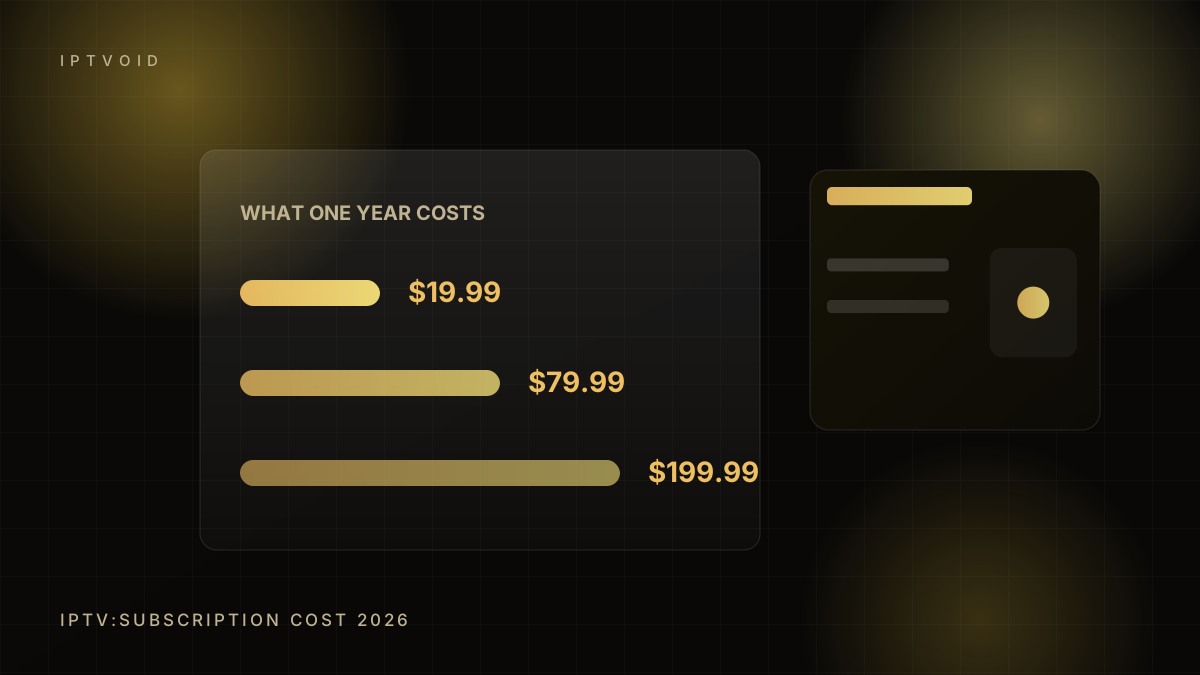
What an IPTV subscription actually costs in 2026
A clear breakdown of IPTV subscription pricing in 2026: monthly vs long-term plans, device counts, hidden costs and how to compare quotes.
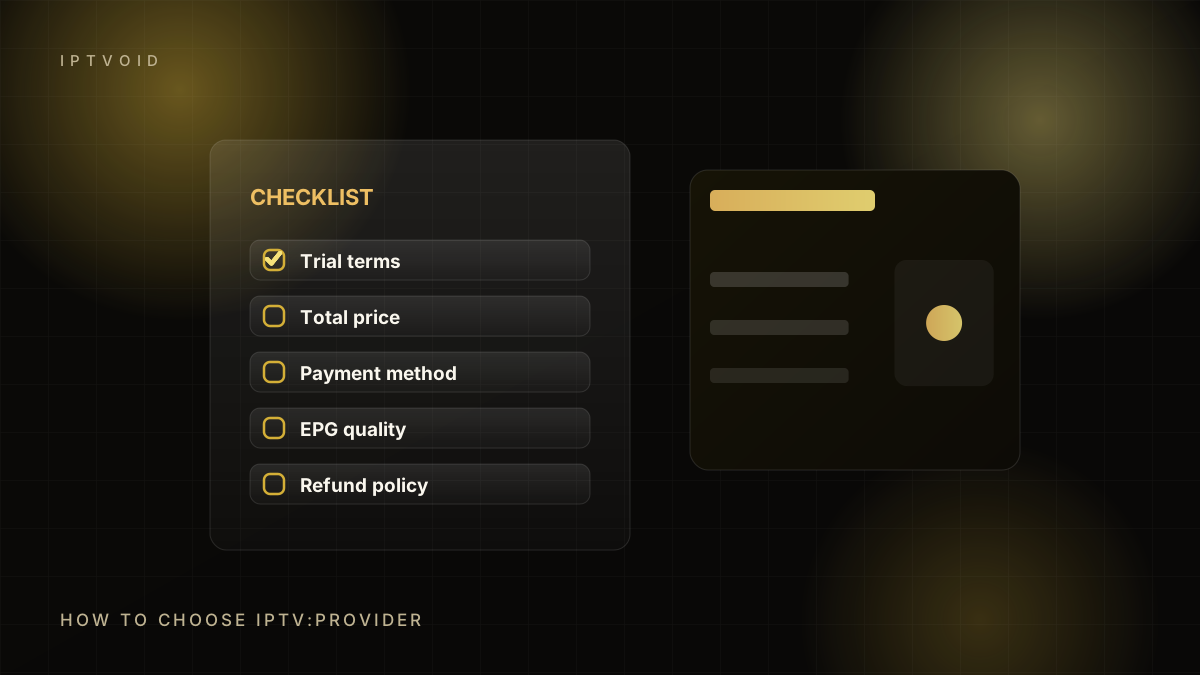
Choosing an IPTV provider without getting burned
A practical checklist for choosing an IPTV provider in 2026: trials, payment risk, support tests, device support, EPG quality and red flags.
Is IPTV legal? A plain-English guide
Is IPTV legal in 2026? The difference between the technology and a service, how licensing works, country differences and the red flags of an unlicensed provider.
Next step
Put the advice into practice
Start with a free trial, test at peak time, then choose the device count and term that fit your household.